
Should I Use API.Bible or Library.Bible?
Should I Use API.Bible or Library.Bible?
If you are building a digital tool to share the Bible, you will come across two major platforms: API.Bible and Library.Bible. Both are operated by American Bible Society to provide digital access to Scripture, but they serve very different purposes. This article explains, in plain English, how to make an informed decision about choosing one of these two services.
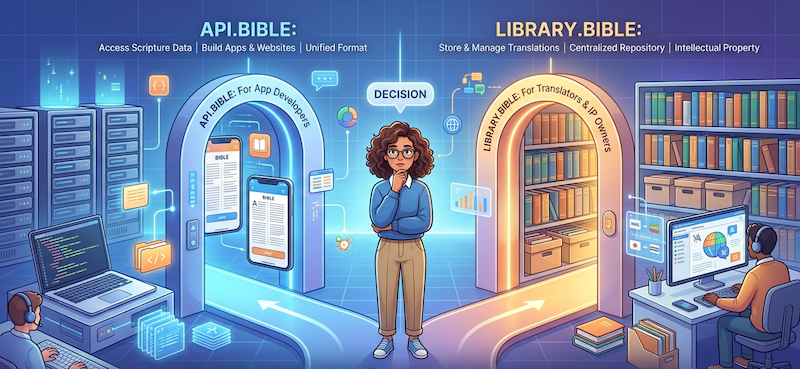
Think of it like this: Library.Bible is a massive, secure warehouse where Bibles are safely stored and preserved. API.Bible is the convenient storefront that lets you “order” specific verses to display instantly on your website or app.
When to Choose API.Bible (“digital storefront”)
API.Bible is designed for developers and creators who want to get up and running quickly. It is a “plug-and-play” service that delivers Bible content over the internet directly into your application.
You should choose API.Bible if:
- You need quick setup: You don’t want to manage giant files; you just want to “request” a verse and have it appear.
- You need popular translations: It provides easy access to many well-known Bible translations through simple licensing plans.
- You need a connected experience: It is optimized for things like daily devotionals, church websites, mobile Bible readers, study tools, or any integration where users stay connected to the internet.
When to Choose Library.Bible (“data warehouse”)
Library.Bible (also known as the Digital Bible Library, or DBL) is the world’s largest collection of Scripture. It houses thousands of languages in various formats like text, audio, video (for sign language) and more. However, it is a high-level repository intended for organizations and translation agencies.
You should choose Library.Bible if:
- You need offline access: You want to download the entire Bible file to store on a device so it works without an internet connection.
- You need formal rights agreements: You are a ministry, translation agency, or distribution organization that needs to negotiate licensing directly with rights holders for large-scale or specialized use.
- You need specialized formats: You aren’t just looking for text, but need raw files for print, audio, or video distribution.
How to Decide: A Quick Checklist
Still not sure? Ask yourself these questions:
- Do I want to build something quickly using a standard web connection? If yes, go with API.Bible. It handles the technical heavy lifting so you can focus on your app’s design.
- Do I need to own the full data files and manage complex legal permissions? If yes, Library.Bible is your destination. It is the gold standard for long-term storage and global distribution.
- Do I need both? Many organizations use API.Bible for their connected apps while relying on Library.Bible for offline distribution or print projects. The two platforms complement each other, and choosing one does not rule out the other.
Summary
Both platforms are essential for spreading the Word of God in the digital age. By choosing the right tool for your specific goal—whether it’s building an engaging Bible app, managing a global translation project, or doing both—you can ensure that Scripture remains accessible to everyone, everywhere.