Should I Use API.Bible or Library.Bible?
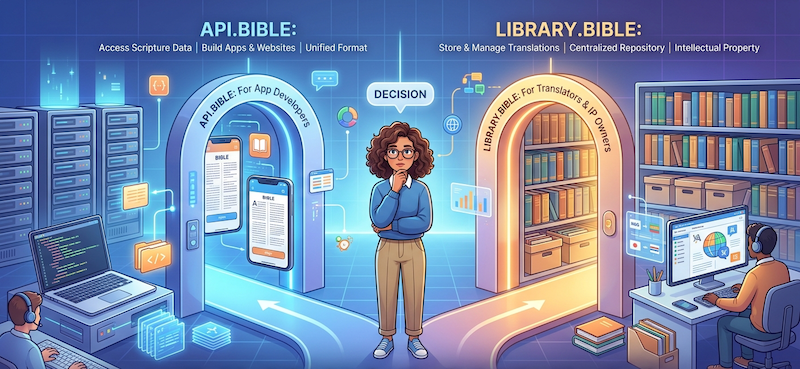
If you are building a digital tool to share the Bible, you will likely come across two platforms operated by American Bible Society: the Digital Bible Library (DBL, at Library.Bible) and API.Bible. They are not competing alternatives. Each serves a different need, and many organizations use them together.
Think of it like this: DBL is the library where Scripture files and licensing agreements are kept, and API.Bible is the delivery service that brings Scripture into your website or app on-demand. This article outlines each product and its primary functionality in order for you to determine which path best fits your project: DBL, API.Bible, or both.
When DBL is the right fit
DBL is the world’s largest collection of Scripture, spanning thousands of languages and formats including text, audio, braille, and video (such as sign language). It is designed for translation agencies and various ministry organizations contributing and distributing Scripture at the file and licensing level.
DBL is likely the better fit if you need:
- The underlying Bible files: You need the complete source files themselves, not just Scripture content delivered on request.
- Formal Controlled Access agreements: Your project requires licensing arrangements made directly with rights holders.
- Specialized formats: You need raw files for print, audio, braille, video, or other specialized distribution.
- Broader distribution rights: Your project involves large-scale or specialized distribution beyond what a standard app integration covers.
An offline experience alone isn’t a reason to choose DBL. API.Bible applications can also cache content, subject to API.Bible’s requirements. DBL becomes the right choice when your offline or distribution plans require the files themselves or rights beyond what API.Bible express licensing provides.
When API.Bible is the right fit
API.Bible is designed for developers and creators who want to get up and running quickly. It delivers Scripture content over the internet directly into your application, so you don’t have to manage large files.
API.Bible is likely the better fit if you need:
- Quick setup: You want to request a passage and have it appear in your app.
- Access to well-known translations: You want Open Access content and popular copyrighted translations through straightforward plans.
- A connected experience: You’re building a daily devotional, church website, mobile Bible reader, study tool, or similar integration.
How DBL and API.Bible fit together
DBL is where Scripture is stored, licensed, and distributed as complete files. API.Bible is where Scripture is delivered into connected applications. Because the two are linked, you don’t always have to choose one over the other:
- DBL only: You need the underlying files and formal agreements for your project.
- API.Bible only: You want to display Scripture in an app or website. API.Bible provides Scripture content; you choose your translations and agree to the applicable license terms through a streamlined checkout process.
- DBL + API.Bible: You are a user within a member organization in DBL who wants to deliver the content you’re already licensed for through API.Bible (see “For organizations” below).
Are you an individual or an organization?
For individuals and independent developers
API.Bible is built for individuals. You don’t need a ministry or organizational affiliation to get started — sign up, get an API key, and start building. The free Starter plan includes Open Access content and a selection of copyrighted Bibles.
DBL, by contrast, is designed for organizations. As an individual, you can browse and download Open Access and Creative Commons translations from DBL, but you cannot apply for a full DBL membership or access controlled-access content without an affiliated organization.
In most cases, independent developers building non-commercial apps won’t need DBL membership at all — API.Bible is the right starting point.
For organizations
DBL is built for organizations — translation agencies, publishers, and ministries that need formal licensing, file management, and controlled access to Scripture content. Organizational membership is required to contribute content, manage licenses, or access controlled-access translations.
If your organization is already a DBL member, you can connect your DBL API Key to an API.Bible app, giving your app access to content you’re already licensed for — delivered through API.Bible’s fast, on-demand service. This is ideal for organizations that manage formal agreements through DBL but also want to power websites and apps without handling raw file delivery themselves.
How to decide: a quick checklist
- Do I want to display Scripture in a connected app or website, quickly? Start with API.Bible. It handles the technical heavy lifting so you can focus on your app’s design.
- Am I an independent developer building a non-commercial app? API.Bible’s Starter plan is likely all you need. DBL membership isn’t required.
- Do I need the underlying Bible files, formal Controlled Access agreements, specialized formats, or broader distribution rights? DBL is your destination.
- Am I already a DBL member who also wants to power an app? Connect your DBL API Key to API.Bible and use both.
Choosing one platform doesn’t rule out the other. Many organizations use API.Bible for connected apps while relying on DBL for files, print, and wider distribution.
Summary
DBL and API.Bible work together to spread the Word of God in the digital age. Whether you’re building an engaging Bible app, managing a global translation project, or doing both, choosing the right path helps keep Scripture accessible to everyone, everywhere.