How to contact a domain name’s owner?
This article explains in plain English for individuals, companies, and organizations to contact a domain name’s owner for a legitimate reason.
Engage Your Audience with a Memorable .BIBLE Domain Name
This article explains in plain English for individuals, companies, and organizations to contact a domain name’s owner for a legitimate reason.
It’s now 2026 and the increased usage of mobile apps has no sign of slowing down. Did you know that Mobile Internet Usage Surpasses Desktop for First Time in October 2016? That was nearly 10 years ago, a whole decade! And, it just so happens that .BIBLE domain names were first publicly available on March 8, 2016.
Have you considered what a Bible app is today? It’s more than just a piece of software. It has the incredible potential to be a digital sanctuary that gives rest to the soul, a study tool that sharpens the mind, and a global mission field that reaches people instantly around the world.
However, with thousands of apps competing for attention in the Apple App Store and Google Play Store, the one thing that stands out to connect your app with the people that need it can most clearly be your app’s domain name. The domain name serves as your digital front door that gets people to your app website, where you can present a lot more information about how your Bible app can help them.
Here are four reasons why a strategic domain name is the most valuable asset for your Bible app: Visibility, Credibility, Relevancy, and Identity.
Visibility is the access point for any digital platform. You could have the most intuitive, feature-rich Bible app in the world, but if users can’t find it, they can’t use it. That results in your app having very little use and minimal impact. A well-chosen domain name is a foundational element of Search Engine Optimization (SEO).
Search engines like Google use the domain name as a primary signal to determine what a website—and by extension, an app—is about. When a user searches for “daily Bible app” or “how to understand the Bible,” having a domain that aligns with those queries gives you a competitive edge. A dedicated domain acts as a landing page that captures web traffic and funnels it directly to your app store links, making another way for users to discover your app..
The higher the ranking you have for your app website, that will display your website and its domain name near the top of the search results page. Being one of the top search results would get your app website more clicks. More clicks means more people visiting your website. And your website will clearly signal to people how to download and install your app on their mobile device. That results in more people using your Bible app.
Keywords within a domain name (e.g., DailyPrayer.bible or StudyTheWord.com) immediately tell the search engine and the user what to expect. While “exact match domains” aren’t the magic bullet they once were, they still hold significant weight in user click-through rates. People are more likely to click on a link that contains the exact words they are searching for. By securing a keyword-rich domain, you aren’t just boosting your rank; you are making it easier for a seeker to find the Word.
In the Christian world, trust is paramount. When users are looking for spiritual guidance and community, they want to know that the source they are engaging with is faithful, reliable, and trustworthy.
A trustworthy domain name acts as a digital “seal of approval.” An app that relies on a long, convoluted URL or a free subdomain (like mybibleapp.hostingsite.com) appears amateurish and feels kind of insecure. Conversely, a clean, custom domain name suggests that the website is operated by an established organization that is committed to its mission. This professional appearance reassures users that your Bible app is being actively developed and reliable to use for months and years ahead.
There is a psychological phenomenon where simplicity equals familiarity, and familiarity equals trust. A short, punchy domain name is easy to remember and share by word of mouth. If a user can easily recall Free.Bible or Library.Bible without having to look it up or spell it out letter-by-letter, the friction is lowered. A memorable name stays in the user’s mind, making your app unforgettable.
For years, .com was the undisputed king of the internet. However, as the digital landscape has matured, Top-Level Domains (TLDs) have become more specialized. For a Bible app, the extension you choose says as much about your mission as the name itself.
The introduction of the .bible extension was a game-changer for faith-based developers. It provides instant context. When a user sees a .bible URL, there is zero ambiguity about the site’s purpose. It creates a “neighborhood” of like-minded organizations, ministries, apps and websites. Using this extension immediately associates your app with the global Bible community, signaling that you are part of a specific, trusted niche.
Domain extensions influence how users perceive the “authority” of a site. While .org suggests a non-profit mission and .com suggests a commercial enterprise, a specialized TLD like .bible suggests intentionality. It shows that you have gone the extra mile to secure a digital identity that reflects your core values. This relevance helps in narrowing the “intent gap”—the space between what a user wants and what they find.
Your brand is the “personality” of your Bible app. In the digital space, where physical touchpoints are non-existent, your brand identity must be communicated through visuals, tone, and—most importantly—your domain name.
A domain name is often the first interaction a user has with your brand. It sets the tone for the entire user experience. If your app is called “The Lamp” but your domain is spiritual-app-123.net, there is a disconnect. A cohesive brand requires that your app name, your social media handles, and your domain name all sing the same note. This consistency reinforces your message and makes your brand feel “larger” and more influential.
In the digital Christian world, branding isn’t about “selling” a product; it’s about stewardship. It’s about presenting the life-changing message of the Bible in a way that is current, accessible, and clear. A strong domain name helps you carve out a unique place in a crowded world. It allows you to move beyond being “just another app” to becoming a recognized resource.
A domain name is far more than a technical requirement. It is a strategic asset that increases visibility, conveys credibility, shows relevancy, and establishes your brand identity. For a Bible app, the right domain is an investment that contributes to accomplishing your mission. By choosing a name that is discoverable, credible, and relevant, you ensure that your digital ministry has the strongest possible foundation for more Bible engagement.
Right now, you can check if your .BIBLE domain name is available for registration. Go to get.bible/register and select any registrar listed. (Domain names are registered on a first-come, first-serve basis. That means you’ll want to act quickly and wisely.)
Want to make a bigger impact online with your Bible-inspired website or app? Now’s your chance!
Starting April 7, 2025, premium .BIBLE domain names are available at lower prices, making it easier than ever for ministries, churches, organizations, and individuals to claim a powerful web address.
Using a premium .BIBLE domain name is more than an ordinary web address—it’s a trusted, memorable, and mission-driven way to share God’s Word in an increasingly digital world. Launched in 2016 by American Bible Society, ABS furthers its mission of making the Bible available to every person in a language and format each can understand and afford, so that all people may experience its life-changing message.
Clear & Memorable – Instantly tells visitors your website is Bible-centered.
Credible & Trusted – Elevates your online presence with a domain that signals purpose.
Stronger Engagement – Helps ministries, churches, and individuals stand out in a cluttered digital space.
Since launching in 2016, thousands of websites have embraced .BIBLE to inspire and connect people with Scripture. Check out some great examples:
With our new lower pricing, getting a premium .BIBLE domain name is easier and more accessible than ever before. Whether you’re launching a new ministry, creating Bible study resources, or building an app to spread God’s Word, now is the perfect time to secure your .BIBLE web address.
Don’t miss out—register your .BIBLE domain today! Go to get.bible/register
Let’s fill the Internet with the message of hope and truth—one .BIBLE domain at a time!
p.s. You may have noticed a new look & design here at get.bible. This redesign has streamlined our web presence. We hope you like it! And, we’d love your feedback—contact us.
About the .BIBLE Top-Level Domain Registry
The .BIBLE top-level domain registry is an initiative of American Bible Society. The .BIBLE registry helps Bible-inspired websites bring clarity to their brand and empower Scripture engagement, translation, innovation, and global partnerships so that all people may experience the life-changing message of the Bible. Learn more at get.bible.
About American Bible Society
For over 200 years, American Bible Society has remained committed to its mission of making the Bible available to every person in a language and format each can understand and afford, so that all people may experience its life-changing message. We believe the Bible is the ultimate source of truth with the power to transform lives and eternities, and for over two centuries, we have seen it do exactly this as millions have received God’s Word and discovered the powerful hope of Scripture and the promise of new life through Jesus Christ. For more information, visit www.americanbible.org
The Internet currently has 1,437 top-level domains (TLDs) as of February 12, 2026. This number may change from time to time, whenever new ones are delegated or old ones get retired. (cf. IANA root zone)
Top-level domains are more commonly known as domain extensions, the portion of a domain name to the right of the dot. A complete list of all the top-level domains (TLDs) on the Internet can be referenced below. (A top-level domain the technical nomenclature for the last part of a domain name, found after the final dot. TLDs are essential for the Domain Name System to direct internet traffic to specific web addresses.)
Before looking at the big list, let’s look at some quick answers about the Internet and its origin story.
Some of you might want to know how many domains exist, in terms of how many registered domain names are on the Internet, you can get that answer at this domainnamestats.com page or The Verisign Domain Name Industry Brief, published quarterly. (One caveat: not every registered domain name has a website connected to it.)
The underlying Internet infrastructure was developed in the 1960s and 1970s. The Internet as we know it today with its domain name system was launched in 1985. The first 6 top-level domains launched are: .COM, .ORG, .NET, .EDU, .GOV, .MIL (cf. IETF RFC 920). As an aside, the term Internet itself was not formally defined until October 1995 (cf. Brief History of the Internet, Internet Society, 1997.)
The Internet is constantly developing and growing in usage, content, and domain names. The number of top-level domains have also grown over the years. For instance, 2-letter country code top-level domains (ccTLDs) like .US, .UK, and .IL were launched first. Since then, over 200 other ccTLDs have become part of the Internet, like .RU, .DE, .JP, and many more.
ICANN (Internet Corporation for Assigned Names and Numbers) has coordinated the Internet domain namespace since 1998. In 2011, ICANN launched the New gTLD Program (2012 program) to expand the Internet namespace. Organizations and companies could apply to operate its own top-level domain. These new TLDs would benefit the global Internet community by providing people with more meaningful and memorable domain names to access Internet resources.
During the rigorous application process, 1,930 applications were submitted for creating new top-level domains in various categories, geographies, brands, and languages. Not all of the applications were approved in the evaluation process and some applications were withdrawn.
By 2017, more than 1,200 new top-level domains have been delegated to the Internet. Add that number to the existing top-level domains. That’s how we have nearly 1,500 TLDs today.
Note that not all top-level domains are available for public registration. Some TLDs have registration requirements (like .NYC, .BANK, and .LAW) and some TLDs are exclusive use by brands (like .GOOGLE, .MICROSOFT, and .BMW). And, would you believe there are discussions in progress that will open up another round of applications for more top-level domains to be added to the Internet? It’s true.
The New Generic Top-Level Domains (gTLD) Program: 2026 Round is an ICANN initiative to enable the expansion of the Internet’s Domain Name System (DNS) through the introduction of new top-level domains. By applying for and securing a gTLD allows a business, community, and other organization the opportunity to create a customized online space to clearly designate a digital neighborhood with many related destinations.
Where can I find a list of all the TLDs on the Internet? The authoritative list of all the top-level domains (TLDs) is maintained by IANA (Internet Assigned Numbers Authority). and the Root Zone Database is updated daily. The current list is at https://data.iana.org/TLD/tlds-alpha-by-domain.txt.
With so many top-level domains and knowing that it changes from time to time, how does one know if a domain name is valid? See this article for A Clear Description for a Valid Domain Name, that also describes which characters are allowed in a domain name.
From the website onemillionmore.bible—
What if ONE MILLION MORE fell in love with the Bible? How can your church, small group & community be transformed? Join the One Million More Challenge!
The Bible Was Written To Communities… Let’s Read It That Way.
Reading the Bible together transformed our church. Now we want to give away everything you need to see it ignite yours:
WHY BOOK CLUBS?
LET’S REDISCOVER “ONE ANOTHER”
The One Million More Bible Reading Challenge is a movement born out of the dream of Pastor Andy Wood from Saddleback Church. After witnessing the transformative power of committing to reading the Bible all together as a church community, the dream was born to invite others to do the same in their communities globally.
The mission is to challenge One Million More people to read the Bible daily, connect with community, grow deeper in their faith, and experience life change through God’s Word. Once we reach one million, we will go for One Million More people, and then One Million More.
This initiative is only possible if we work together. We invite you to join the efforts and join the passionate leadership of Tyndale, The Bible Project, Our Daily Bread, The Small Group Network, Celebrate Recovery, and Lumivos. Together, we’re providing resources, tools, and community support to help believers everywhere engage with Scripture like never before.
Join in this God-sized dream as we transform lives, one verse, one person, and One Million More at a time!
Visit the website onemillionmore.bible
Since our beginning, the .BIBLE top-level domain (TLD) partnered with YouVersion, the maker of the Bible App, to fulfill our respective missions. One of the projects is providing the fastest Bible on the internet by making available fast-loading AMP pages for every Bible verse. (Every Bible verse is optimized for search engines and designed to load as fast as possible using Accelerated Mobile Pages (AMP) specifications.) And, what’s super nice is this online Bible website has no ads! No advertising to distract you from reading the pure Word of God.
To make it easy to remember and to access, users can add the .BIBLE ending to any book of the Bible. And, voila, before you can say Mississippi, there’s the Bible on your web browser. Here’s the 66 books of the Bible in alphabetical order:
You may have noticed .BIBLE verses being shared on social media, too. When you use the YouVersion Bible app, that directly links users to these fast-loading Bible verses. For example, here are the latest tweets with psalm.bible.
Install the free Global Bible Widget to enhance the user experience on your website or blog. Just add Javascript code to your website HTML.
One important consideration for selecting a domain name is how it would help with better placement in search engine results with the highest possible ranking. This is one of the most prominent factors that is part of the art and science of SEO, or search engine optimization.
With nearly a thousand new domain extensions now available on the internet, including .bible, .church, .faith, and .media, there are so many more great choices available for getting a better domain name—a domain that’s shorter, shareable, and memorable. And, a domain name is certainly a most significant factor that’s used to determine your website’s ranking in search engine results. (Research has found over 1,000 factors used in ranking algorithms for popular search engines like Google and Bing.)
Our .BIBLE team has noticed 7 particular domain names using the new extensions and how they have stood out in search engine results:
STL.CARS is the new domain name for St. Louis Motorcars, switched from its previous domain name STLMotorcars.com in November 2015. An in-depth case study researched the impact of this change to STL.CARS and found the following:
Free.bible is the fastest way to download and to share the YouVersion Bible App and it ranks #8 for searches on the phrase “free bible” without extra optimizing of the website. (Note that these rankings are during the time of this blog post and are subject to change over time.)
Deaf.bible is the home page for the Deaf Bible app in 18 sign languages and it ranks #3 for searches on the phrase “deaf bible”.
Newlife.bible is the home page for the mobile app to “Explore what God, faith and Christianity are all about.” This website ranks #4 when searching for “newlife bible” but ranks #1 for the exact phrase “newlife bible”.
Life.church is the website for the often-recognized innovative church located in multiple locations with its central office in Edmond, Oklahoma, and Life.Church switched their domain name in October 2015 from their previous LifeChurch.tv domain. How can 2 letters make a difference? Bobby Gruenewald, Life.Church innovation pastor, explained why:
Coffee.club was launched back in November 2014 and was ranked on page 1 of search results within a week. It continues to rank near the top of searches for the phrase “coffee club” to this day.
Home.barclays is the website address for Barclays Bank, an international bank based in the United Kingdom (with 325 years of history and operating in 40 countries) switched over in May 2015 from its previous .com and .co.uk URLs. 5 of the benefits for this new domain extension is listed by Barclays Group’s Chief Information Security Officer:
These are just a handful of examples for how these new domain extensions are shaping the future of the Internet. Instead of an online world with domain names ending in .COM or .NET that only tells you that it’s a website, organizations and companies can now use every character in the domain name to meaningfully connect with people with its compelling message.
One more thing to note. It’s not just about how your website’s ranking in search results; it’s also about how your domain name stands out.
A website’s ranking in search results isn’t the only thing that people look for when deciding on which website to click on. “Domain bias” describes the behavior of how users choose which search result to click on based on the domain name. As described in this article, Turn Domain Bias In Search Results To Your Advantage, about the in-depth study:
“… searchers prefer to click on exact match domains, and are actually 25 percent more likely to click them. In other words, if Joe Searcher is looking for “Home Football Jerseys” to wear to a big game, he is more likely to click on FootballJerseys.com than Overstock.com/sports or GoTeam.com.”
Read the detailed report, Domain bias in web search, from Microsoft Research.
Here’s a list of 66 Ideas for .BIBLE Domain Names, with many practical ideas for using .BIBLE domain names to build Bible websites, apps, and resources that help to increase Bible engagement.
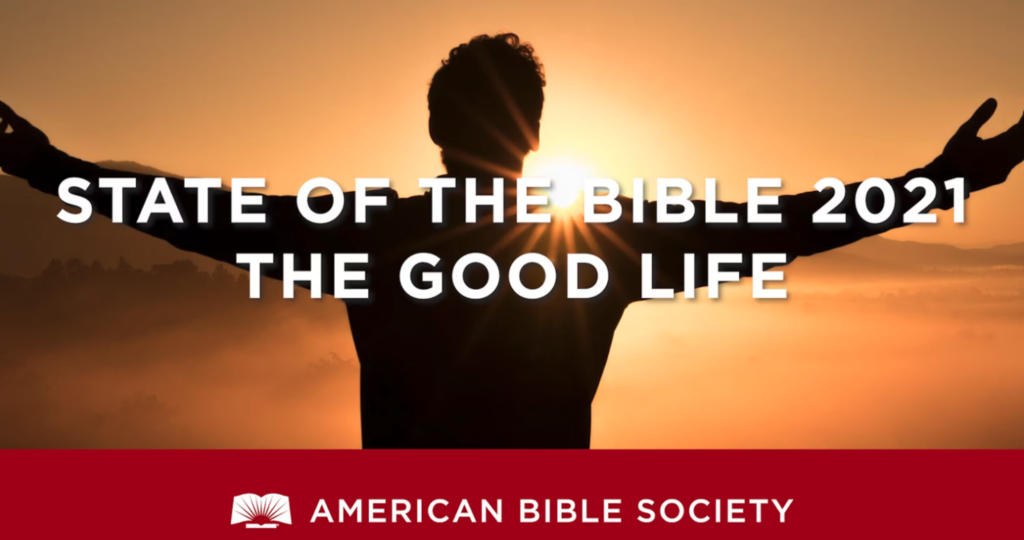
The great research team at American Bible Society has synthesized its years of learnings into a Pathway of Scripture Engagement to visualize what a person’s and a group’s concrete steps and milestones for engaging with the Bible. The definition for Scripture engagement is: consistent interaction with the Bible that shapes people’s choices and transforms their relationships with God, self, and others. (source: State of the Bible 2021)

And this webinar about the State of the Bible 2021 report further explains the good life that the Bible brings about many benefits of human flourishing and quality of life.
With valuable information gathered and analyzed through methodical research, we have confirmation, reassurance, and evidence of the Bible’s life-changing message. But one of the question remains: how can we increase Bible engagement? It doesn’t happen by just knowing information or even benefits or instructions for how to do something.
For example, to help people go from 1 hour of Bible engagement by attending a church worship service, towards doing a daily Bible reading for 15 minutes a day, that’s a significant and sizeable increase in Scripture engagement, right? In the pathway chart, this could be mapped as someone going from step 4 to step 5.
If someone starts a new behavior, according to behavior economist Dan Ariely (Duke University), they’d need more fuel and less friction: “building a behavior change program is like building a rocket ship: it has to have enough fuel (motivation) and have little enough friction (barriers) to get from the status quo to the new destination.“
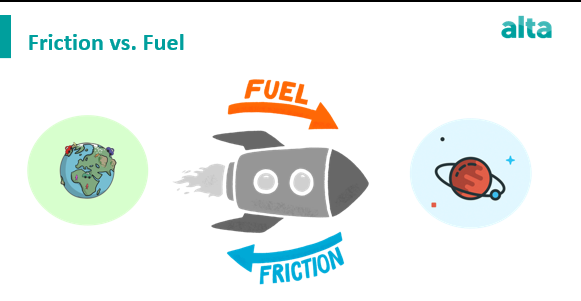
Staying with our example above, then, what are the things that can be done to fuel and motivate someone to want to change their behavior, from just going to church once a week, to reading the Bible daily? And, if that’s too big of a change, as it well may be for many, what is an easier step that would lower the friction and resistance to change? This very useful model for behavior change also indicates how it’s considerably easier to reduce friction than it is to increase fuel to motivate people into new actions, even if all the benefits were clearly spelled out and people would agree to them being beneficial.
On another note, based on 30 years of helping churches with Bible engagement, Whitney T. Kuniholm has identified 4 principles that will make any church-wide Bible reading program more effective:
Sticking with the behavior change program model from Dan Ariely, it’s easy to see how .BIBLE domain names help to reduce the friction and increases the likeliness for someone to engage the Bible in a number of ways:
People are 25% more likely to click on a .BIBLE link when searching for relevant Bible content. With over 1,500,000 monthly searches on the keyword Bible at Google around the world (according to searchvolume.net), your web link will stand out in search results and that results in more web traffic.
When people remember your website or app link, they’re going to your website and coming back again. With so much information already occupying our minds and thousands of messages bombarding our brains daily (though the estimated daily volume of brand messages vary), a branded domain name using .BIBLE grabs attention better than anything else. Almost every time I talk about working with the .BIBLE Registry, that opens up longer conversations and holds people’s attention.
The fastest Bible on the internet is powered by .BIBLE domain names, thanks to our partnership with YouVersion. Over 2,000,000 links are shared on social media to this collection of Bible pages in AMP (Accelerated Mobile Page) format and increasing Bible engagement digitally.
Easy-to-remember .BIBLE domain names can help you access the Bible anywhere anytime, without downloading or installing an app, on any internet-accessible device at links like genesis.bible, matthew.bible, luke.bible, psalm.bible, and every book of the Bible. It doesn’t get any easier or faster!